Every single person I’ve helped get started in crypto has asked me this same question, almost word for word: Bitcoin or Ethereum, which one first? I asked it myself once too, and spent an embarrassing amount of time reading conflicting opinions before I just picked one and learned as I went.
There’s no single right answer here, but understanding what each one actually does, how they’ve performed, and what kind of risk you’re taking on will get you to a confident decision a lot faster than I got to mine.
- Bitcoin is digital gold: a decentralized store of value with a fixed supply of 21 million coins.
- Ethereum is programmable infrastructure, powering smart contracts, DeFi, and decentralized apps.
- Bitcoin has the longer track record and more institutional backing, from firms like BlackRock and Fidelity.
- Both are genuinely volatile. Only invest what you could afford to lose, and secure whatever you buy in your own wallet.
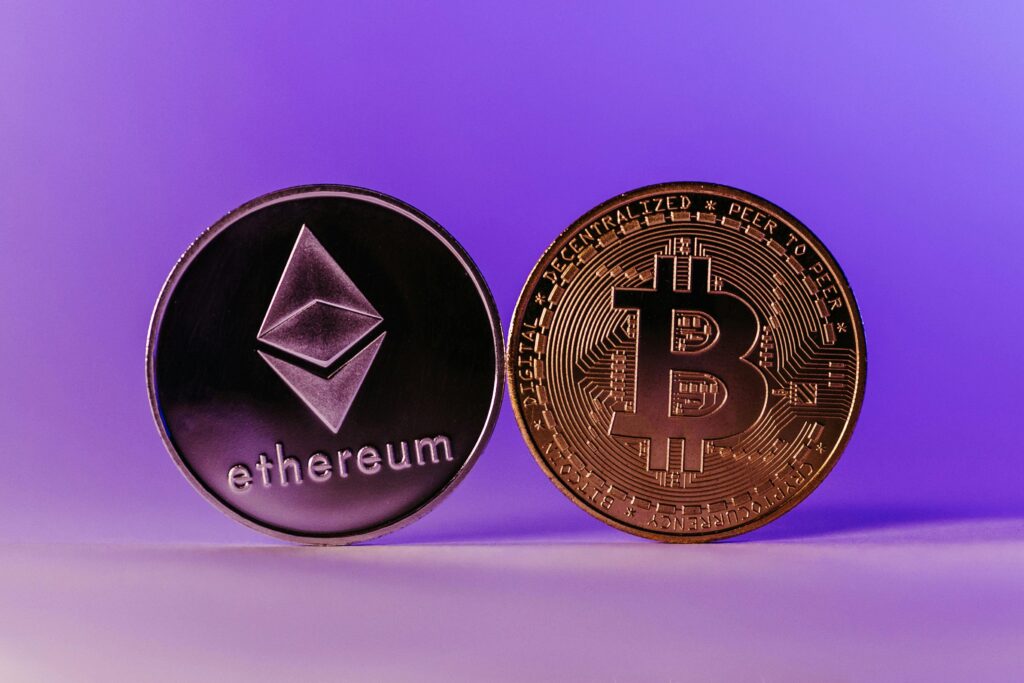
What Actually Makes Them Different
Bitcoin was the first cryptocurrency ever created, launched in 2009 by the pseudonymous Satoshi Nakamoto. Its purpose was straightforward: a decentralized digital currency that lets people send and receive money without going through a bank. Its design is intentionally simple and conservative, with a hard cap of 21 million coins, giving it a scarcity model similar to gold. That’s exactly why people call it digital gold rather than a technology platform.
Ethereum arrived in 2015 with a much broader ambition. Created by Vitalik Buterin, it was designed not just as a currency but as a programmable blockchain, introducing smart contracts, self-executing agreements written directly into code. That opened the door to decentralized apps and entire ecosystems like DeFi and NFTs.
So at their core, these two assets are solving different problems. Bitcoin wants to be a reliable store of value. Ethereum wants to be the infrastructure layer for a new kind of internet. Neither is better in an absolute sense, they just serve different purposes, and that distinction matters when you’re deciding where to put your money first.
Which Has the Stronger Track Record

Bitcoin has the longest performance history in the market, and it’s worth taking seriously. From essentially zero in 2009, it climbed to nearly $69,000 in November 2021, corrected significantly, and has since recovered and broken new highs. That boom-and-bust-and-recover pattern doesn’t guarantee anything about the future, but it has given institutional investors more confidence in Bitcoin than almost any other crypto asset.
Ethereum has delivered remarkable returns of its own since launch, at times rivaling Bitcoin’s growth. Its transition to proof-of-stake in September 2022, known as The Merge, cut its energy consumption by over 99 percent and changed its economic model in ways many analysts believe could make it deflationary over time.
That said, Bitcoin’s track record is longer and more widely recognized by traditional finance. Major asset managers now offer Bitcoin ETFs, a level of institutional validation Ethereum is still working toward. Ethereum’s trajectory is far from weak, but the two simply have different lengths of history behind them.
Understanding the Risk in Each
All cryptocurrency is volatile, and neither of these is an exception. Bitcoin is generally considered the less risky of the two simply because of its age, liquidity, and market dominance, which tends to make it more stable relative to smaller assets, including Ethereum.
Ethereum carries additional layers of risk worth understanding. Because it’s a platform supporting a wide range of applications, its value is tied to actual usage and developer activity, not just speculation. That’s a strength, but it also means Ethereum is more exposed to technical risk, protocol changes, and competition from platforms like Solana and Avalanche.
There’s regulatory risk too, for both. Bitcoin is more consistently classified as a commodity in the US, while Ethereum’s status has been less clear, particularly since its move to proof of stake. Understanding that you could lose a meaningful portion of your investment in either asset is worth sitting with before you commit real money.
The Wallet I Use to Keep My Bitcoin Safe.
Get My Ledger Now →How to Actually Buy Whichever One You Choose

Once you’ve done your research and feel ready, the process is simpler than most people expect. Most major exchanges let you sign up, complete identity verification, deposit funds, and buy your chosen crypto within minutes. Binance remains a solid, widely used option and it’s the one I started on myself, available across most of the world including the US, though currently unavailable in Europe following its EU suspension in July 2026. If you’re in the EU, I’ve covered the licensed alternatives in Best Crypto Exchanges for Europeans in 2026.
Once you’ve bought your crypto, the next important step is deciding where to store it. Leaving coins on an exchange is convenient but carries risk, since exchanges can be hacked or fail. A hardware wallet like Ledger keeps your private keys completely offline, meaning even if your computer is compromised, your funds stay safe. For anyone holding a meaningful amount, I’d consider it essential rather than optional.
It’s also worth starting small, regardless of which asset you choose. Most exchanges let you buy fractional amounts, so you don’t need a whole coin to get started. Investing only what you can afford to lose, and avoiding emotional decisions during market swings, separates long-term investors from people who panic-sell at the worst possible moment.
How to Actually Decide
This is the part I won’t do for you, and honestly, I don’t think anyone should. What I can offer instead is a way to think it through for yourself.
If simplicity, the longest track record, and the most institutional validation matter most to you, that points toward Bitcoin. If you’re genuinely drawn to the technology itself, the applications being built on it, and you’re comfortable with a bit more complexity and risk, that points toward Ethereum. Plenty of people end up owning both, treating one as a steadier core holding and the other as something they believe in for different reasons.
There’s no universally correct answer here, only the one that fits your own goals, risk tolerance, and curiosity. Whichever way you lean, start with a small amount, secure it properly, and give yourself time to actually learn as you go rather than trying to get it perfectly right on day one.

FAQs
Is Bitcoin or Ethereum a better investment?
Neither is universally better. Bitcoin suits investors who want simplicity and the longest track record; Ethereum suits those interested in the broader technology and application ecosystem.
Can I buy both instead of choosing one?
Yes, and many experienced investors do exactly that, treating Bitcoin as a core holding and Ethereum as a smaller, secondary allocation.
Is Ethereum riskier than Bitcoin?
Generally yes, since its value depends on usage, developer activity, and competition from other smart contract platforms, in addition to normal market volatility.

Do I need a lot of money to start?
No. Most exchanges let you buy fractional amounts, so you can start with a small sum and grow from there.
Should I keep my crypto on the exchange after buying?
I wouldn’t. Moving meaningful holdings into your own hardware wallet protects you from exchange-side risk entirely.
Is Binance available everywhere?
It works across most of the world, including the US, but is currently unavailable in the EU following its 2026 suspension there.
Have a question I didn’t cover? Leave it in the comments below and I’ll get back to you.
New articles, straight to your inbox.
Whether you’re just curious or already investing, you belong here.
Join HereNot Sure Where to Start? Grab My Free Crypto Starter Guide.
Get the Guide Now →Sources:
CoinDesk historical price reporting;
Investopedia cryptocurrency fundamentals;
Ledger security documentation.

Written by Yana Ballantyne
Founder of Yadala · Crypto Educator · Swiss Real Estate Advisor
Yana is a German-born, Australia-raised investor with two decades of experience across property, shares and crypto. She founded Yadala to make crypto simple and accessible for women — without the jargon or the overwhelm. She recommends platforms she believes in but will never tell you which coin to buy. That decision is always yours.

Disclaimer & Affiliate Disclosure
This article contains affiliate links. If you purchase through these links, I may earn a small commission at no extra cost to you. I only recommend products and services I personally use and genuinely believe in. Your support helps me keep Yadala running and free to read — thank you.
The content on Yadala is for informational and educational purposes only. Nothing here constitutes financial, investment, or legal advice. I am not a licensed financial advisor. All opinions expressed are my own personal views based on my own research at the time of writing.
Cryptocurrency and Bitcoin investments are highly volatile and speculative. The value of digital assets can rise and fall dramatically, and you could lose your entire investment. Regulatory changes may also significantly impact the value or legality of cryptocurrency in your country. Never invest more than you can afford to lose completely.
Yadala and its author accept no liability for any financial loss or damage arising from decisions made based on information in this article. Always conduct your own research and consult a qualified financial advisor before making any investment decisions.