How to Read a Crypto Price Chart: A Beginner’s Guide
If you’ve ever pulled up a crypto chart and felt like you were staring at a foreign language, you’re not alone. All those lines, colored bars, and zigzagging patterns can look overwhelming at first. But here’s the truth: reading a crypto price chart is a learnable skill, and once you understand the basics, you’ll start seeing the market in a completely different way. This guide breaks it all down clearly, so you can start making sense of what those charts are actually telling you.
What a Crypto Price Chart Actually Shows You
A crypto price chart is a visual record of how the price of a cryptocurrency has moved over time. At its most basic level, it plots price on the vertical axis and time on the horizontal axis. Every point on that chart represents what buyers and sellers agreed a coin was worth at a specific moment.
What makes crypto charts particularly useful is that they capture market sentiment in real time. When prices rise sharply, it usually means demand is outpacing supply. When they fall, sellers are in control. The chart doesn’t lie about what’s happening, even when the headlines do. Learning to read it means you’re working with actual market data rather than hype or fear.
Most charting platforms let you adjust the time frame you’re viewing. A one-minute chart shows price movement minute by minute, which is useful for active traders. A daily or weekly chart smooths out the noise and gives you a broader picture of where a coin has been and where it might be heading. For beginners, starting with the daily or weekly view is usually the most informative and least overwhelming option.
Candlestick Charts: Reading the Basics Clearly
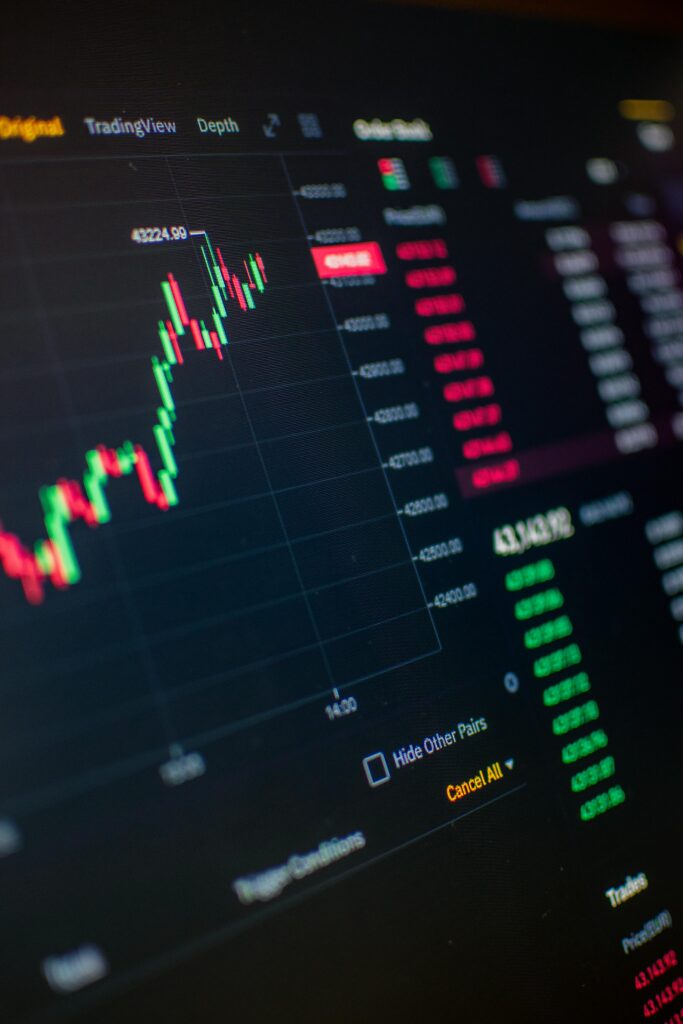
The most common chart type you’ll encounter is the candlestick chart, and it’s worth spending time understanding it properly. Each candlestick represents price movement during a specific time period. A daily chart shows one candle per day. A one-hour chart shows one candle per hour. Each candle tells you four things: the opening price, the closing price, the highest price reached, and the lowest price reached during that period.
The body of the candle is the thick rectangular section. If the candle is green (or white on some platforms), the price closed higher than it opened, meaning it was a positive period. If the candle is red (or black), the price closed lower than it opened, meaning it was a negative period. The thin lines extending above and below the body are called wicks or shadows, and they show the highest and lowest prices hit during that time, even if the price didn’t stay there.
Reading a series of candlesticks together starts to tell a story. A string of green candles with small wicks suggests steady, confident buying. A series of long red candles with large upper wicks often signals that buyers tried to push the price up but sellers repeatedly knocked it back down. Platforms like Binance offer excellent built-in charting tools where you can practice reading candlestick patterns on live and historical data without needing a separate tool.
How Support and Resistance Levels Work
Support and resistance are two of the most practical concepts in technical analysis, and they’re easier to understand than they sound. A support level is a price point where a cryptocurrency has historically struggled to fall below. Think of it as a floor. Every time the price drops to that level, buyers tend to step in and push it back up.
Resistance is the opposite. It’s a price ceiling where the asset has repeatedly struggled to break through. Sellers tend to become more active at resistance levels, which puts downward pressure on the price. When you spot these levels on a chart, you’re identifying zones where significant buying or selling has happened before, and where it’s likely to happen again.
These levels aren’t magic lines, but they reflect real human behavior and market memory. When a price breaks through a resistance level and holds above it, that resistance often becomes new support. This flip is one of the most reliable patterns in charting and gives you useful reference points when you’re thinking about entry or exit points for a trade. Marking these levels on your chart before making any decision is a habit worth developing early.
Why Trading Volume Matters More Than You Think
Volume refers to the total amount of a cryptocurrency that has been traded during a given time period. It’s usually displayed as a bar chart along the bottom of the price chart, and most beginners ignore it completely. That’s a mistake. Volume is what gives price movements their credibility.
A price breakout on high volume is far more meaningful than the same breakout on low volume. If Bitcoin surges 10% in a day but only a small number of coins changed hands, that move might not sustain itself. If the same move happens with three times the average daily volume, it suggests strong conviction behind the price change. Volume confirms whether a trend has real participation behind it or whether it’s a thin, easily reversed move.
Volume can also warn you before a reversal happens. If a cryptocurrency has been climbing steadily but volume starts to dry up, it often means the buying momentum is fading. Sellers can start to take control even before the price starts to drop visibly. Watching volume alongside price is one of the simplest ways to add a layer of context to what you’re seeing on a chart.
Using Chart Data to Decide When to Buy or Sell
Chart reading isn’t about predicting the future with certainty. It’s about improving your odds by making decisions based on data rather than emotion. When you combine what you know about candlestick patterns, support and resistance levels, and volume, you start to build a clearer picture of whether a given moment is a reasonable time to buy, sell, or wait.
A practical approach for beginners is to look for confluence, which means multiple signals pointing in the same direction. If a coin is sitting near a well-established support level, volume is increasing, and the candlesticks are showing reversal patterns like a bullish engulfing candle, that’s a more compelling case for a potential entry than any single signal on its own. The more factors align, the stronger the setup.
That said, no chart setup guarantees a particular outcome. Crypto markets are volatile, and even the cleanest-looking chart can be disrupted by news, regulation, or broader market shifts. Use chart data as one input in your decision-making process, not the only one. Set clear price targets and stop-loss levels before you enter any position, so you’re acting on a plan rather than reacting to price movement in the moment.
Reading a crypto price chart takes practice, but it’s one of the most empowering skills you can develop as an investor. Once you understand what candlesticks are telling you, where support and resistance sit, and how volume confirms or questions a price move, you’re no longer guessing. You’re analyzing. Start by pulling up a chart on a platform like Binance, pick one coin you’re interested in, and spend time just observing before you do anything else. The more charts you look at, the faster your pattern recognition will develop.
5 Key Takeaways
- A crypto price chart shows you the history of price movement, which reflects real buying and selling behavior rather than opinion or speculation.
- Candlestick charts give you four data points per period: open, close, high, and low. Green candles mean the price rose; red candles mean it fell.
- Support levels act as price floors and resistance levels act as price ceilings, based on where significant buying and selling has occurred historically.
- Volume confirms whether a price move is meaningful. High-volume moves carry more weight than low-volume ones.
- Look for confluence before making a decision: the more signals that align in the same direction, the stronger the potential setup.
Disclaimer: This article is for educational purposes only and does not constitute financial advice. Cryptocurrency investments carry significant risk, including the potential loss of your entire investment. Always conduct your own research and consult a licensed financial advisor before making any investment decisions. Some links in this article may be affiliate links, which means Yadala may earn a commission if you sign up through them, at no extra cost to you.